VR Arcade Houston: How Free-Roam VR at Zero Latency Compares to Standard VR Pods
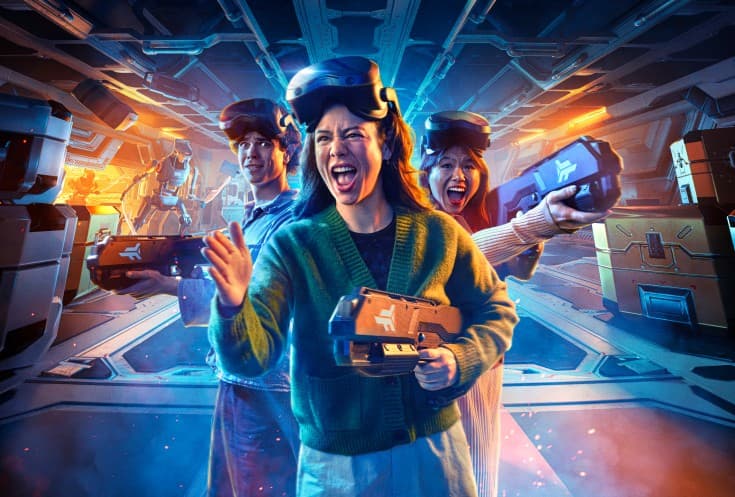
Zero Latency Houston is not a VR arcade (VRA) in the traditional sense — it is a free-roam virtual reality (FRVR) arena operating on fundamentally different technology and a different business model. Traditional VR arcades use individual stationary or room-scale headset pods, each player occupying approximately a 2 by 2 meter (6.5 by 6.5 foot) zone. Free-roam VR at Zero Latency Houston uses a shared arena spanning thousands of square feet, with multiple players tracked simultaneously in the same physical space. The operational difference produces an experience that is categorically different from anything available at a standard VR arcade.
Houston has several locations offering stationary VR pod experiences, where individual players wear headsets in small designated floor squares or booth-style enclosures. These setups typically use consumer-grade headsets, including HTC Vive (VIVE), Oculus Meta Quest, and Valve Index hardware. The per-person cost at stationary VR arcades is generally lower and session lengths are shorter. The trade-off is that social interaction between players happens outside the headset — participants experience separate virtual environments and cannot share the same virtual space simultaneously. At Zero Latency Houston, all players inhabit the same virtual world at the same time.
The technology advantages of Zero Latency Houston over stationary VR arcades in Houston come down to 3 core elements. First, proprietary wireless backpacks eliminate cable tethering entirely — players can sprint, sidestep, and turn 360 degrees without restriction or safety risk. Second, arena-scale motion tracking provides sub-millimeter positional accuracy across the full arena for all players simultaneously. Third, a distributed rendering architecture processes each player's visual field independently, maintaining the frame rates necessary for motion sickness prevention even with 8 simultaneous active users.
For groups specifically, the practical difference between Zero Latency Houston and a stationary VR arcade is shared presence. In a stationary arcade, 6 people can play VR simultaneously but each experiences an individual, isolated virtual environment. In Zero Latency Houston's free-roam arena, 6 players inhabit the same virtual world at the same time — visible to each other as avatar characters, audible through a shared audio channel, and physically responsive to each other's real-world positions. This shared presence produces the social moments — tactical coordination, laughter, synchronized reactions — that make Zero Latency Houston the group-entertainment choice.
Pricing comparison between Zero Latency Houston and stationary VR arcades in Houston is straightforward for groups of 4 or more. At that group size, the per-person cost at Zero Latency Houston is comparable to or lower than the aggregate cost of booking the equivalent number of stationary pods at a traditional VR arcade for the same duration. For 2 or 3 players, stationary VR arcades may offer a lower total cost for a shorter experience. The value proposition shifts decisively toward Zero Latency Houston as group size increases, because the shared arena scales to 8 players at the same per-person rate.
The Houston VR market includes Sandbox VR and Hologate as other group-oriented VR formats active in the broader Texas market. Zero Latency Houston is part of the Zero Latency VR global network — a distinction that provides a proprietary game library, purpose-built hardware, and an operational standard not available at independently operated VR arcades. The 8-person capacity, the depth of the game library across 8 titles, and the free-roam format collectively make Zero Latency Houston the Houston metro's highest-capacity and most technologically advanced group VR venue.
Ready to Experience Zero Latency Houston?
Book your free-roam VR session today. Walk-ins welcome when available.
Book Your Session